
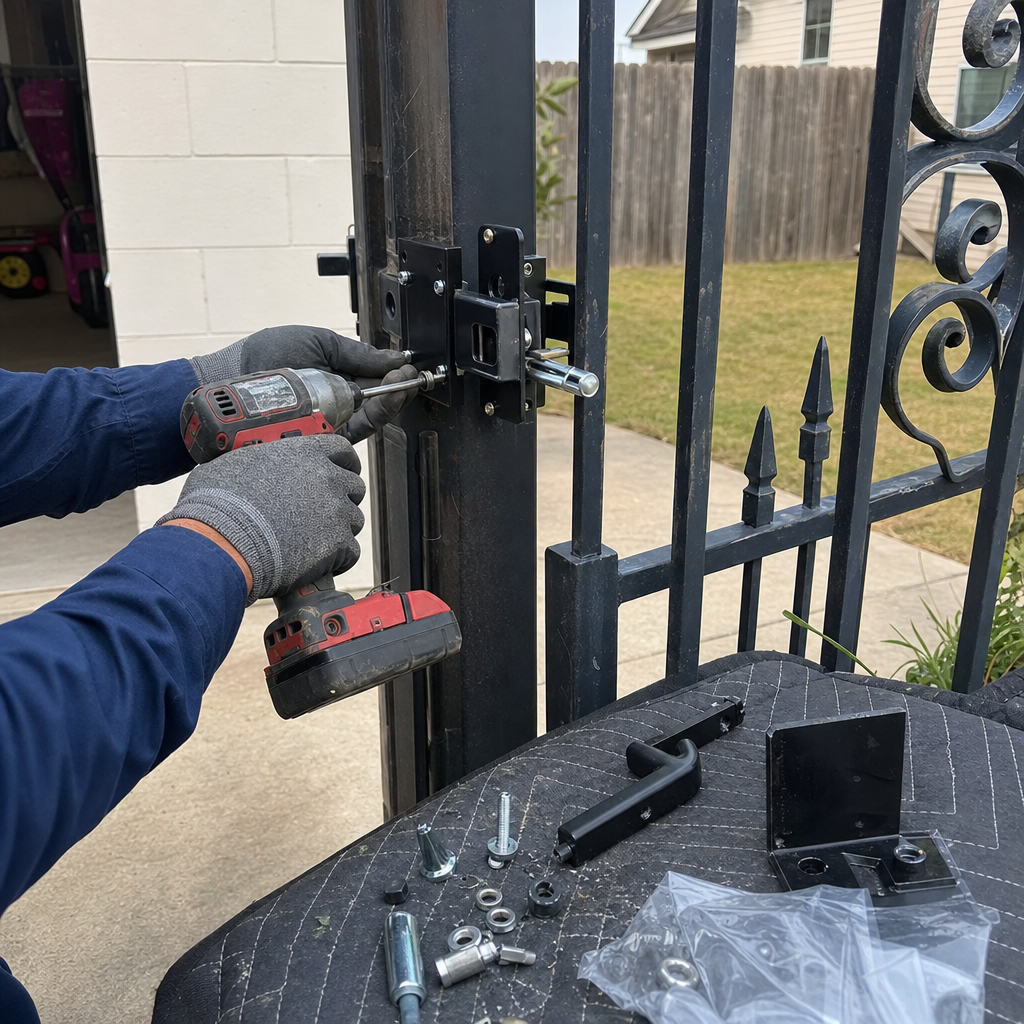
Last updated July 15, 2026
The Complete Guide to Gate Repair in Von Ormy
Most gate failures in Von Ormy don’t start with the gate — they start with the ground beneath it. Caliche soil, which runs through much of this stretch of southwestern Bexar County, expands and contracts with seasonal moisture changes in ways that gradually pull posts out of plumb, stress hinges, and eventually force operators to work so hard they burn out entirely. By the time a homeowner notices the gate is dragging or the motor is grinding, the mechanical symptoms are real — but the root cause is in the foundation. This guide walks through every system in a residential or commercial gate, explains how Von Ormy’s specific climate and soil conditions accelerate certain failures, and tells you exactly what to document before you call a technician so you get a straight quote, not a fishing expedition.
Quick Answer
Gate repair in Von Ormy typically involves diagnosing one or more of five systems: the post and foundation, the hinges or rollers, the gate operator, the safety sensors, and the control board or access panel. Because caliche soil in this area shifts seasonally, many mechanical failures trace back to foundation movement — meaning adjusting hardware without correcting alignment will not produce a lasting fix. A qualified gate specialist can usually identify the root cause in a single site visit and complete most repairs the same day.
Table of Contents
- How Von Ormy’s Caliche Soil Causes Gate Failures
- System-by-System Failure Guide: What’s Actually Breaking and Why
- South Texas Heat and the Nine Gate Brands: What Changes in the Repair Approach
- Is It a Foundation Problem or a Mechanical Problem? How to Tell
- How to Document a Gate Failure Before You Call
- Gate Repair vs. Full Replacement: A Practical Decision Framework
- Gate Repair Pricing Ranges in Von Ormy
- Common Mistakes to Avoid
- When to Call a Professional
- Frequently Asked Questions
- The Bottom Line
How Von Ormy’s Caliche Soil Causes Gate Failures
Caliche is a hardpan calcium carbonate layer found throughout south-central Texas, and Von Ormy sits squarely in the zone where it’s dense enough to create serious long-term problems for any structure with a fixed concrete footing. The issue isn’t that caliche is soft — it’s that it behaves differently than standard clay or loam soil when moisture levels change. During Von Ormy’s dry summers, caliche layers contract slightly and can fracture. During wet winters or after heavy rain events — which the area sees periodically off the Medina River corridor — the soil absorbs water and expands. A gate post set in a concrete footing surrounded by caliche will experience lateral pressure from all sides as that cycle repeats year after year.
What this looks like in practice: a post that was perfectly plumb when installed tilts one to three degrees over two or three seasons. That tilt changes the geometry of a swing gate’s arc. The gate no longer closes flush against the latch post. The operator arm — whether it’s a LiftMaster or a FAAC linear actuator — begins pushing at a slightly wrong angle, adding load to the motor it was never designed to carry. Internally, motor brushes wear faster. Capacitors are stressed. In Viking and Elite operators, the internal limit switches start tripping inconsistently because the gate doesn’t reach the same position on every cycle. The owner calls us about a “motor problem,” and we find a quarter-inch post tilt that started the whole chain.
In Von Ormy specifically, we see this pattern most frequently on properties along Culebra Creek Road and on the older ranch-style homesteads southeast of Loop 1604 where original gate posts were set without deep enough footings for caliche conditions. The fix isn’t always a full reset — sometimes we can re-plumb a post with minimal excavation — but it must be addressed before any operator or hardware repair will hold.
System-by-System Failure Guide: What’s Actually Breaking and Why
A gate is five systems working in sequence. When one fails, the others compensate — and eventually fail too. Here’s how to read each system’s failure signature.
1. Post and Foundation
The post is the anchor for everything else. Failure signatures include a gate that visibly sags on one end, a latch that no longer lines up, or an operator arm that appears strained or bent even though it’s mechanically intact. In Von Ormy’s caliche conditions, foundation failures are slow and easy to miss until a secondary system gives out. Check for plumb using a level on both sides of the hinge post after any mechanical repair — if it’s off by more than one degree, address the foundation first.
2. Hinges and Rollers
Swing gate hinges in South Texas corrode faster than manufacturer specs predict because the combination of summer heat, humidity spikes, and caliche dust is abrasive. Failure signatures: visible rust weeping, squealing on open/close, a gate that swings smoothly in one direction but binds on the return. Slide gate rollers crack when UV-degraded plastic meets the thermal expansion of a steel track that’s been sitting in direct sun at 105°F. We fabricate replacement hinge assemblies in-house when OEM parts are discontinued or carry long lead times — a capability that matters on older Viking and Elite installations common in this part of Bexar County.
3. Gate Operator (Motor)
The operator is the most-blamed component and often the most innocent one. Failure signatures: motor hums but doesn’t move the gate (usually a capacitor or a gate that’s physically stuck), gate moves slowly or stops mid-travel (limit switch, thermal cutout, or misalignment load), gate reverses unexpectedly (obstruction detection triggered by a dragging frame). LiftMaster operators log fault codes that a technician can read with the right interface. FAAC and BFT operators require brand-specific diagnostic equipment — which is exactly why many handymen decline to work on them.
4. Safety Sensors
Photo-eye sensors and loop detectors are designed to stop or reverse a gate when something is in the way. In Von Ormy, dust accumulation on sensor lenses is a major cause of false trips, especially during dry months when caliche dust is airborne. Failure signatures: gate reverses at end of travel for no visible reason, gate won’t close at all, gate closes then immediately opens. Misaligned photo-eyes are a five-minute fix. A damaged inductive loop in a concrete driveway is a more involved repair — but still far cheaper than a new operator if that’s what another company incorrectly quotes you.
5. Control Board and Access Control
The control board is the brain of the system. Failure signatures: operator receives power but does nothing, remote triggers work intermittently or not at all, keypad entry codes stop functioning. Lightning strikes are a leading cause of board failures in Von Ormy — the area’s flat terrain and open ranch land make gate systems on exposed properties vulnerable during spring storm season. DoorKing and Linear access control systems have proprietary boards that require brand-specific replacement parts; using generic substitutes voids compatibility and usually produces intermittent failures that are harder to trace.
South Texas Heat and the Nine Gate Brands: What Changes in the Repair Approach
Von Ormy regularly sees summer temperatures above 100°F for extended stretches, and gate operators are rated to specific ambient temperature thresholds. When those thresholds are exceeded repeatedly, failure timelines compress. Here’s how that affects the nine brands we work on:
- LiftMaster: Thermal protection trips more frequently in summer. If your LiftMaster RSL12U or LA500 stops mid-cycle on hot afternoons, check the thermal cutout before assuming motor failure. Usually resolves with shade cover and a wait period — but repeated trips signal the motor is working harder than designed, which points back to alignment or load issues.
- FAAC: FAAC operators use hydraulic fluid in many models. South Texas heat thins hydraulic fluid faster than in northern climates, causing sluggish operation or reduced torque. Fluid type and fill level should be checked annually in Von Ormy — most owners don’t know this is a maintenance item.
- BFT: BFT’s control boards handle heat well relative to competitors, but the plastic gear housings on some BFT worm-drive units soften under sustained high heat and can strip. We’ve seen this on south-facing installations with no shade coverage.
- Linear: Linear access control panels are common on multi-tenant properties in the Von Ormy commercial corridor. Their boards are heat-tolerant but sensitive to voltage spikes from aging transformers — a more common issue on rural properties with long wire runs from the panel.
- Viking: Viking industrial swing gate operators hold up well in heat but the internal limit cams are adjustment-sensitive. Caliche-related post movement throws off limit settings fast; re-calibration after any foundation work is mandatory.
- Ghost Controls: Ghost Controls solar-powered operators are popular on ranch properties outside Von Ormy’s residential core. Battery capacity drops noticeably in sustained heat — a battery that performs fine in March may not complete a full open/close cycle in August. Annual battery replacement is the right call here, not operator replacement.
- DoorKing: DoorKing telephone entry systems require a live phone line or cellular connection. In rural Von Ormy, cellular signal gaps can cause intermittent failures that mimic board problems. We verify signal quality before touching the hardware.
- Elite: Elite operators are durable but less commonly stocked by local distributors, meaning parts may require a lead time. We keep a supply of the most common Elite capacitors and limit switch assemblies specifically because of how many older Elite installs we see in this part of Bexar County.
- Mighty Mule: Mighty Mule is a common DIY operator on lighter residential swing gates. The lighter-duty construction means heat and alignment stress take a toll faster. We can repair Mighty Mule units, but on gates over 400 lbs or longer than 16 feet, we often recommend an upgrade to a commercial-grade operator — the Mighty Mule simply wasn’t built for that load profile.
Is It a Foundation Problem or a Mechanical Problem? How to Tell
This is the single most important diagnostic question in Von Ormy gate repair, and it’s the one most often skipped by technicians who aren’t specialists. For a complete overview, see our Gate Repair Maintenance Checklist for Von Ormy Homeowners. Here’s a practical field test you can perform before calling anyone:
- Disconnect the operator. On most swing gate operators, there’s a manual release lever. Engage it so the gate swings freely by hand.
- Open and close the gate manually. Note whether the gate swings smoothly through its full arc without lifting, dragging, or binding. If it drags on the ground at any point in the arc, the geometry is off — either from a tilted hinge post or a warped gate frame.
- Check latch alignment. Does the latch striker meet the catch square-on, or is there a visible vertical or horizontal offset? An offset of more than half an inch almost always indicates post movement, not hardware wear.
- Check hinge post plumb. Place a level on the hinge post at two heights: near ground level and at the top. If readings differ, the post has moved. Even a one-degree variation can create enough geometric error to strain an operator significantly.
- Reconnect the operator and observe. Watch the operator arm through a full cycle. If it flexes or appears to push against resistance at end-of-travel, and the gate passed the manual swing test, the problem is likely limit switch calibration. If the gate dragged manually and the arm is straining, you have a foundation-first situation.
A mechanical adjustment made without correcting a foundation problem will fail again — typically within one season in Von Ormy’s soil conditions. Any technician who adjusts the operator without checking post plumb first is setting you up for a repeat call.
How to Document a Gate Failure Before You Call
A good technician can quote more accurately — and skip the exploratory time you’d otherwise pay for — if you arrive at the call with specific information. Here’s exactly what to note:
- Describe the failure behavior precisely. “It stopped working” is not useful. “The gate opens fully but won’t close — it moves about two feet toward closed then reverses” is a diagnostic starting point. Write down what the gate does, not just what it doesn’t do.
- Note the operator brand and model. It’s usually on a label on the motor housing. Take a photo. If it’s a LiftMaster, note the model number — the difference between an LA400 and an LA500 changes the parts list significantly.
- Note how old the system is. “We bought the property in 2019 and it was already here” is useful context. Systems over 10 years old in Von Ormy’s climate often have heat-fatigued capacitors and sun-degraded wiring insulation regardless of brand.
- Record what recently changed. Heavy rain? A vehicle impact? A power surge? A repair attempt? Any of these change the diagnosis path.
- Take a short video. Pull out your phone and run the operator through one full cycle while filming. A 30-second video of a gate that stutters, reverses, or makes unusual noise can eliminate an entire category of possible failures before a technician arrives on-site.
- Check the obvious. Is the gate physically obstructed? Is the power outlet the operator is plugged into working? (Test it with a phone charger.) Is the photo-eye lens visibly dirty or misaligned? Document what you checked and the result.
Gate Repair vs. Full Replacement: A Practical Decision Framework
The repair-versus-replace question comes up on every job that involves an operator over eight years old or a gate frame with visible structural damage. Here’s how we think through it:
- Repair makes sense when: The gate frame is structurally sound, the operator failure is a single component (capacitor, control board, limit switch), the post and foundation are stable, and the repair cost is less than 50% of replacement cost.
- Replacement makes sense when: The frame has multiple broken welds or significant corrosion, the operator has failed twice in three years (indicating systematic overload from alignment issues), the system is a low-duty-cycle residential operator on a gate it was never rated for, or the property owner wants to upgrade to smart access control.
- The Von Ormy factor: Because caliche soil puts higher long-term stress on gate systems than typical suburban conditions, operators on properties with known foundation movement history tend to have shorter useful lives. If a post has moved and wasn’t corrected, factor that ongoing stress into any repair investment decision.
We’ll give you an honest answer on this during any estimate visit. If a repair is a short-term patch that will fail again in 18 months, we’ll tell you that directly rather than take the repair revenue now and the replacement revenue later.
Gate Repair Pricing Ranges in Von Ormy
Gate repair costs in Von Ormy vary significantly based on the system involved and the scope of the underlying problem. The following ranges reflect real-world jobs in this market — not national averages that don’t account for the South Texas cost of materials and the diagnostic complexity of caliche-related failures.
| Repair Type | Typical Range (Von Ormy Market) |
|---|---|
| Photo-eye sensor realignment or replacement | $85 – $195 |
| Capacitor replacement (most operator brands) | $110 – $220 |
| Control board replacement | $180 – $450 depending on brand |
| Hinge repair or replacement | $150 – $380 |
| Limit switch calibration or replacement | $95 – $210 |
| Operator arm or linear actuator replacement | $280 – $650 |
| Full gate operator replacement (installed) | $650 – $1,800 depending on operator class |
| Post re-plumb / foundation correction | $350 – $900 depending on depth and soil conditions |
| Gate frame weld repair | $200 – $550 depending on damage extent |
These are ranges, not quotes. A free estimate from a technician who’s actually looked at your gate is the only accurate number. Call (830) 541-7476 and we’ll schedule a no-cost site visit.
Common Mistakes to Avoid
- Adjusting the operator without checking post plumb first. This is the most common DIY and handyman error in Von Ormy. Any operator adjustment made on a tilted post is a temporary fix — the misalignment load will re-emerge within weeks or months.
- Using generic replacement boards on FAAC, BFT, or DoorKing systems. Proprietary control boards from these brands are not interchangeable with generic aftermarket alternatives. A non-OEM board may power on and appear to function, then fail intermittently in ways that are nearly impossible to trace without brand-specific diagnostic tools.
- Ignoring a Ghost Controls battery warning in summer. In Von Ormy’s heat, a battery showing 70% capacity on a cool morning may not complete a full gate cycle at 2:00 PM in August. “The battery light isn’t on” is not a reliable indicator of adequate capacity once temperatures are sustained above 95°F.
- Assuming a reversing gate means a bad motor. A gate that reverses mid-travel or at end-of-travel is almost always reacting to obstruction detection — either a dirty photo-eye, a misadjusted sensitivity setting, or a gate that’s dragging due to alignment. Replacing the motor first is an expensive way to discover the motor was fine.
- Skipping the manual swing test after a rain event. Heavy rain in Von Ormy softens the caliche layer temporarily. A gate that was running fine before a significant rain event may have experienced enough post movement during soil saturation to be visibly out of alignment afterward. Test the gate manually after any major rainfall before concluding you have an electrical failure.
- Hiring a general handyman for a brand-specific access control repair. DoorKing and Linear access control systems require programming access that most general contractors don’t have. A handyman who replaces a board without proper programming will leave you with a system that accepts no codes — requiring a second service call from a specialist anyway.
- Delaying a weld repair on a cracked frame. A cracked weld on a gate frame in Von Ormy’s humidity will rust through faster than in drier climates. A crack that’s a two-hour weld repair today becomes a frame replacement in 18 months if left unaddressed.
When to Call a Professional
Call a gate specialist — not a general handyman — in any of the following situations:
- The gate has struck a vehicle, person, or structure — safety sensor calibration must be verified by someone with proper testing equipment.
- The operator is drawing power but not moving the gate — this usually indicates a capacitor, board, or mechanical obstruction that requires correct diagnosis before parts are ordered.
- You’ve had the same mechanical adjustment made twice in one year and it keeps failing — this is the clearest sign of an underlying foundation issue.
- The gate system involves FAAC, BFT, or DoorKing components — these brands require brand-specific tools and programming access.
- There’s visible corrosion, broken welds, or bending in the gate frame — structural work requires welding capability, not just hardware replacement.
Precision Gate Repair Experts Von Ormy offers free estimates anywhere in Von Ormy and the surrounding area. Edward Harris, Owner & Lead Technician, personally handles diagnostic visits so you get an honest assessment from the person making the repair decision — not a salesperson relaying information. Call (830) 541-7476 to schedule.
Frequently Asked Questions
How much does gate repair cost in Von Ormy, TX?
Most gate repairs in Von Ormy fall between $85 and $650 depending on the system involved and the scope of the failure. Simple fixes like sensor realignment or capacitor replacement are on the lower end; control board replacement or post re-plumb work runs higher. Operator replacement with installation typically ranges from $650 to $1,800 depending on the operator class and brand. Call (830) 541-7476 for a free on-site estimate — it’s the only accurate number for your specific gate.
Why does my gate keep reversing when it tries to close?
A gate that reverses during closing is almost always triggering its obstruction detection system. The three most common causes are a dirty or misaligned photo-eye sensor, a gate frame that’s dragging on the ground due to alignment issues, or an obstruction sensitivity setting that’s been knocked out of calibration. Check your photo-eye lenses for dust — Von Ormy’s dry conditions mean caliche dust buildup is a frequent culprit — and run the gate manually to see if it drags at any point in the arc.
How does caliche soil in Von Ormy affect my gate?
Caliche soil expands when wet and contracts when dry, which puts cyclical lateral pressure on gate post footings over time. Posts that weren’t set deep enough for caliche conditions — typically less than 36 inches in this area — will gradually shift out of plumb, misaligning the gate’s travel arc and placing excess load on the operator. We see this most often on properties that were gated five or more years ago without caliche-specific footing depth and concrete mix. The repair isn’t always a full reset; sometimes re-plumbing a post with targeted excavation is sufficient.
Can you repair FAAC, BFT, or DoorKing gates in Von Ormy?
Yes — these are three of the nine brands we’re specifically trained and equipped to service. FAAC and BFT operators require brand-specific diagnostic interfaces and, in FAAC’s case, knowledge of the hydraulic fluid system that most general repair services don’t have. DoorKing access control systems require proprietary programming software to configure or restore entry codes after a board replacement. We carry the tools and parts for all three. See our full brand capabilities at the Precision Gate Repair Experts Von Ormy home page.
Is it worth repairing an older gate operator, or should I replace it?
If the operator has failed once and the failure is a single component — a capacitor, a limit switch, a control board — repair usually makes financial sense, especially if the gate frame and foundation are sound. If the operator has failed more than once in three years, or if it’s been working harder than designed due to uncorrected alignment issues, replacement with a properly rated unit is the better long-term investment. We’ll give you both numbers during the estimate visit and let you decide — there’s no pressure toward replacement if repair is the right answer.
How do I know if my gate problem is the operator or the foundation?
Disconnect the operator using the manual release and swing the gate by hand through its full arc. If the gate drags, binds, or the latch doesn’t align, the problem is geometric — meaning the post or frame — and no amount of operator adjustment will produce a lasting fix. If the gate swings freely and latches square with no effort, the problem is in the electrical or mechanical operator system itself. This one test eliminates an entire category of failures and should always be the first step before any repair is attempted.
The Bottom Line
Gate repair in Von Ormy is a soil problem as much as it is a mechanical problem. Caliche conditions, sustained summer heat, and the specific failure profiles of the major gate brands all interact in ways that generic repair guides don’t address. The most important things to take from this guide: check your post plumb before you adjust anything mechanical; understand which brand you have before ordering parts; document the failure behavior precisely before you call; and don’t mistake a foundation problem for an operator problem. Explore our more guides & resources for additional help. When the failure is beyond a straightforward DIY fix, the right specialist diagnoses faster and repairs correctly the first time — which is always cheaper than a sequence of wrong repairs. For anything in Von Ormy, we’re the call to make.
For customers in neighboring communities, we also cover Gate Repair in Lackland Air Force Base, Gate Installation in Lackland Air Force Base, and Gate Motor & Opener in Lackland Air Force Base — same owner, same standards, same commitment to getting it right.
Ready for a straight answer on your gate? Call (830) 541-7476 for a free estimate. Edward Harris, Owner & Lead Technician at Precision Gate Repair Experts Von Ormy, will be on the job — not a subcontractor, not a scheduling coordinator. 613 customers have rated us 4.9 stars because that’s the standard we hold ourselves to on every single call.
Written by Edward Harris, Owner & Lead Technician at Precision Gate Repair Experts Von Ormy, serving Von Ormy since 2014.